
We've also released a followup article with our thoughts on how AI and AI based talks should be represented at Momentum
Momentum 2025 was just half a year ago and yet we’ve seen a marked rise in the capabilities of LLMs and the maturity of agentic AI development tools such as Cursor, Copilot, Claude, Codex, Antigravity, and others. At Momentum we believe that this is a critical industry shift to be aware of and informed of and felt the need to gather attendee thoughts on how prevalent AI should factor into Momentum 2026, coming October 15th this year.
To help with this effort one of our organizers, Ryan Echternacht, created a Greater Cincinnati AI Adoption Survey initiative to gather attendee thoughts in a standardized form and perform some analysis on the results.
The survey is still open, if you’d like to participate.
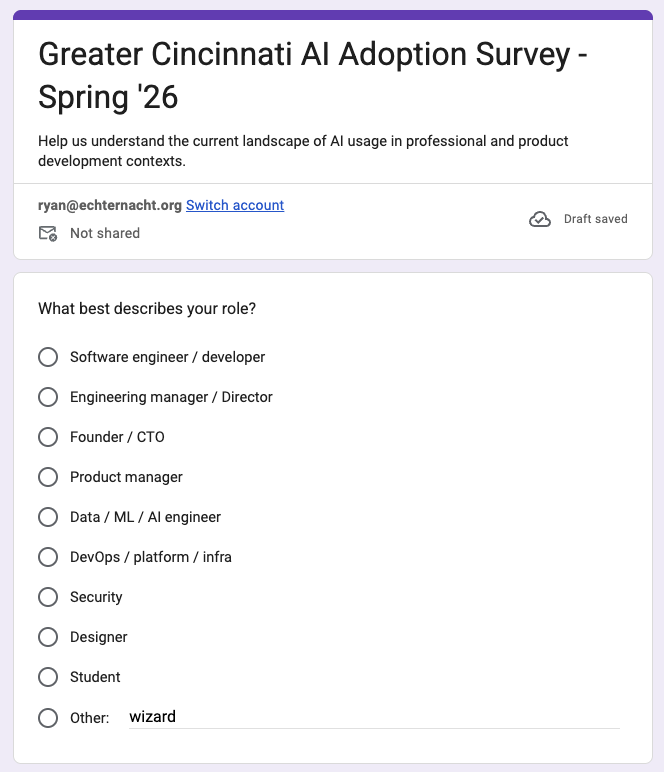
This post summarizes our key findings from the many of you that helped that initiative by providing your thoughts and talks about what, if anything, we plan to change for Momentum 26 - besides the lunch sandwich logistics!
TL;DR?
Momentum is still going to be awesome and have a variety of content. We ran this survey to make sure the talks we’re attracting and selecting are in line with our community's interest, especially with regards to AI. This is our understanding of the survey results and we’ll post soon about how this will (or won’t) affect our call for speakers.
Key Results
We’ll start by covering some of our key takeaways from looking over the data, then move on to what we’re doing differently this year because of these insights. The highlights are:
- Most respondents are already using AI daily or multiple times a day
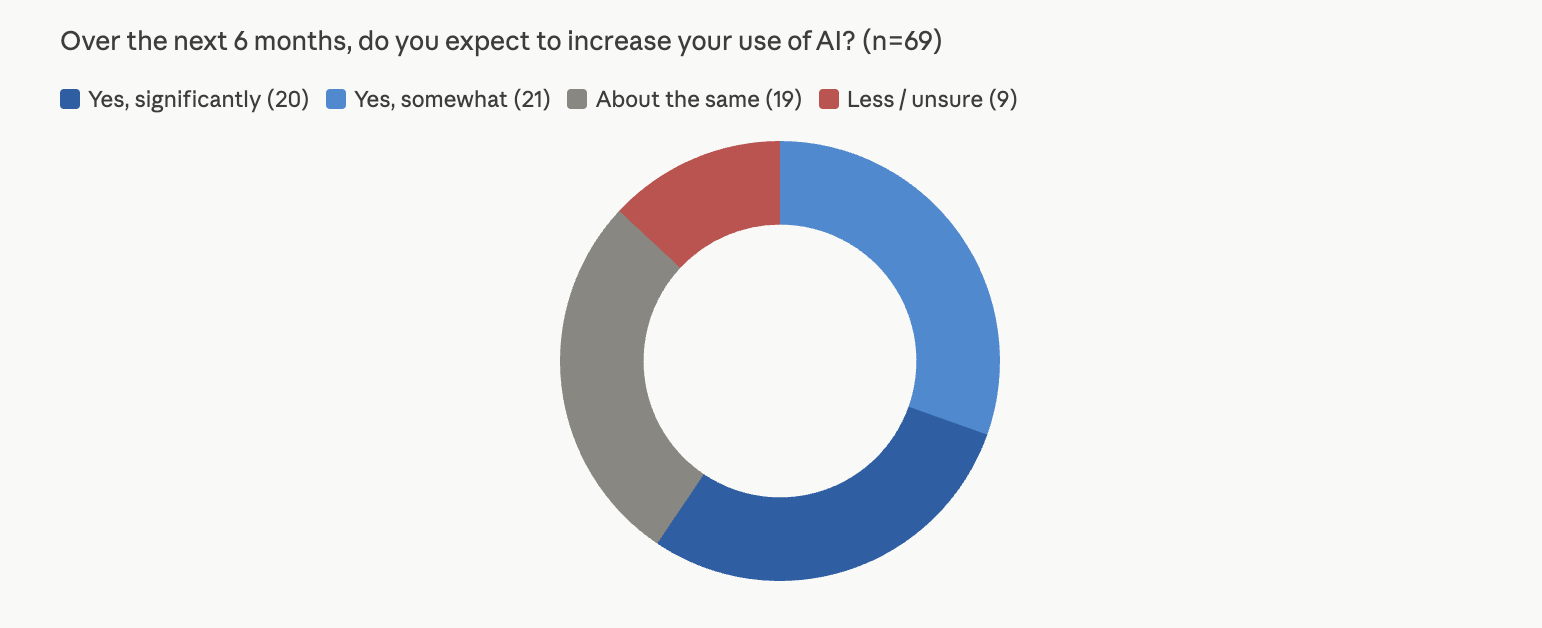
- 60%+ expect their AI usage to grow over the next six months
- 75%+ of organizations have rolled out or are actively rolling out AI
- 60% are worried about code quality and loss of craftsmanship — many of the same people expecting to use AI more
- Security and compliance concerns are blocking more than half of respondents in one form or another
AI Adoption Is Already Here, and It's Being Driven from the Bottom Up
As of early this year, the majority of respondents were using AI on at least a daily basis with many others using AI weekly or less frequently, and a handful of folks who were not yet using AI in their workflows.
This tracks well with the observations of our leadership team: many developers love to try out the latest and greatest, whether in their day-to-day work or in their hobbyist endeavors, while others point to the many flaws and pitfalls of AI agents, which are inherently non-thinking in nature, attempting to perform development or development-adjacent work that inherently benefits from careful thought and experience.
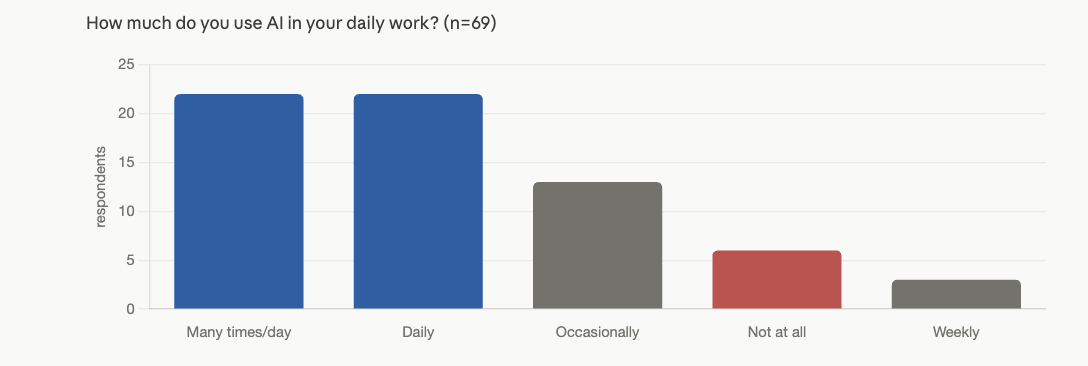
Whether or not you’re using AI right now, we do see many organizations and individuals looking for ways to incorporate AI more into their workloads, whether this is to stay informed, increase productivity, satisfy leadership / investors, or simply to develop skills.
Roughly ⅔ of attendees surveyed expected the use of AI to grow in their organizations with ⅓ of respondents predicting a significant amount of growth.
So, this begs the question: who’s driving the change towards additional AI usage? Obviously models and tools are getting better, but what’s the driving force within organizations?
AI adoption is being driven by technologists
It turns out that AI adoption is generally coming from down in the trenches first and foremost. While leadership is certainly aware of AI and is keenly interested in it, over half of respondents indicated that AI adoption in organizations is coming from individuals or teams with only a quarter of respondents indicating that a company-wide strategy is truly driving their AI adoption.
"I'm both frightened by it and firmly think that it's the future of software engineering. I think this is an internet/cell-phone/computers-first-introduced moment where those who don't adapt will be left behind."
Looking at roadblocks to AI adoption, the most significant ones are a lack of expertise and cultural factors, though these challenges apply to roughly one third of respondents.
The result is clear: organizations are driving towards AI and that drive is largely coming from people like you. Beyond this, the two largest factors that seem to be slowing AI adoption at the moment are a lack of expertise in these areas and cultural factors related to the usage of AI.
How Will AI Affect Software as a Craft?
While technologists are driving us towards AI adoption in the Cincy tech community at the moment, that’s not to say that this adoption is one without fear and trepidation.
There’s a very real concern with technologists that we may be turning off our brains and embracing vibe coding tendencies and YOLOing the resulting code into prod. 60% of all respondents are concerned about code quality and reliability declining as AI usage continues or increases in the future.
"I'm focused on learning how to use it better, but not allow it to fully do my job. I'm also learning how to guard against skill atrophy and not reach for AI when the task is trivial for me to do without."
Beyond this, many developers are truly concerned about what our new agentic AI development tools will mean to the skills of new or existing software developers who develop an over-reliance on capable models and tools and who may not truly develop or maintain the software craftsmanship skills needed to be effective engineers for their organizations.
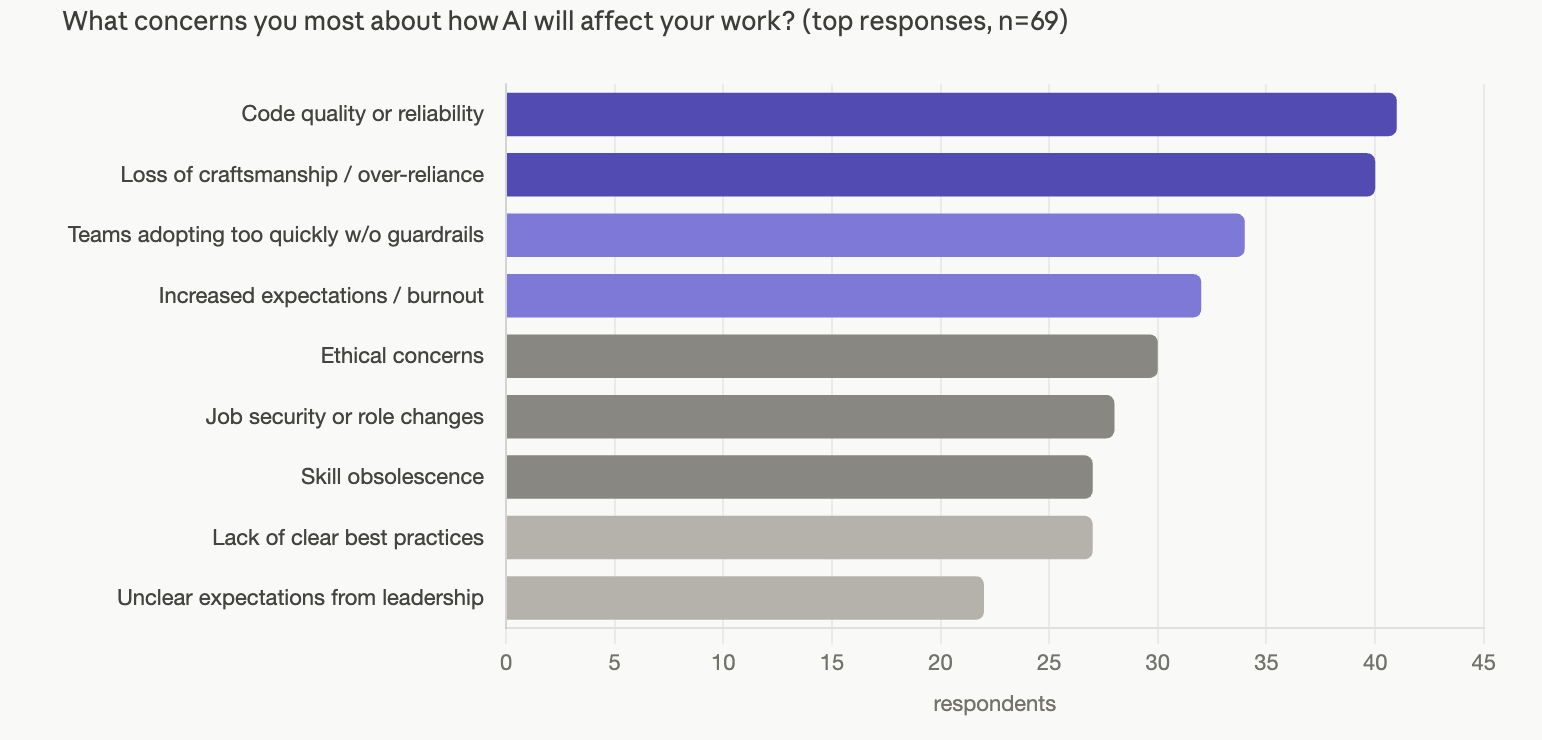
Additionally, respondents are worried that their existing skills and knowledge will become obsolete as AI can instantaneously retrieve knowledge and talents resembling their own at a casual examination, leading to concerns about job security and a scarcity of new opportunities.
"Very scared that coding agents are good enough (or will soon be good enough) that my role as a software developer will completely disappear, and I might not have a career anymore."
Security and Compliance Fears are Real
It stands to reason that if attendees are worried about the quality of their code and the full capabilities of these models and tools, their anxiety likely also extends to security and compliance concerns as well, whether a fear of AI generated code introducing new security vulnerabilities, concerns about supply-chain issues, or concerns about how the organization’s data and source code are used or retained by AI tooling including the large language models themselves.
In fact, over half of respondents indicated that their concerns with security and compliance in a world of increasing AI prevalence impacts them in the following ways:
- Creating additional barriers to them personally being able to use AI
- Company-wide challenges governing AI usage and securing code and data assets
- Challenges building features involving AI capabilities
Clearly, the interest and understanding in AI tooling is there, but some significant obstacles and concerns overshadow our usage of AI.
Our Takeaways for Momentum 2026
So, what does this mean for Momentum 2026? How should the conference we all love participating in and organizing change to adjust to these changing times?
People don’t want it to be an “AI Conference” but…
It’s clear that Momentum should cover AI in at least as much depth as we’ve covered it the past few years where we had at least one AI or AI-related talk each hour, but how much is too much? Are attendees looking for a quarter of the conference to be AI related? Half? A full AI conference?
From our analysis, the answer to at least this last one is a clear and resounding “no way!” with the greatest chunk of respondents being less interested in Momentum if Momentum were specifically branded as an AI conference - which confirmed many of our suspicions on the leadership team coming into this survey project.
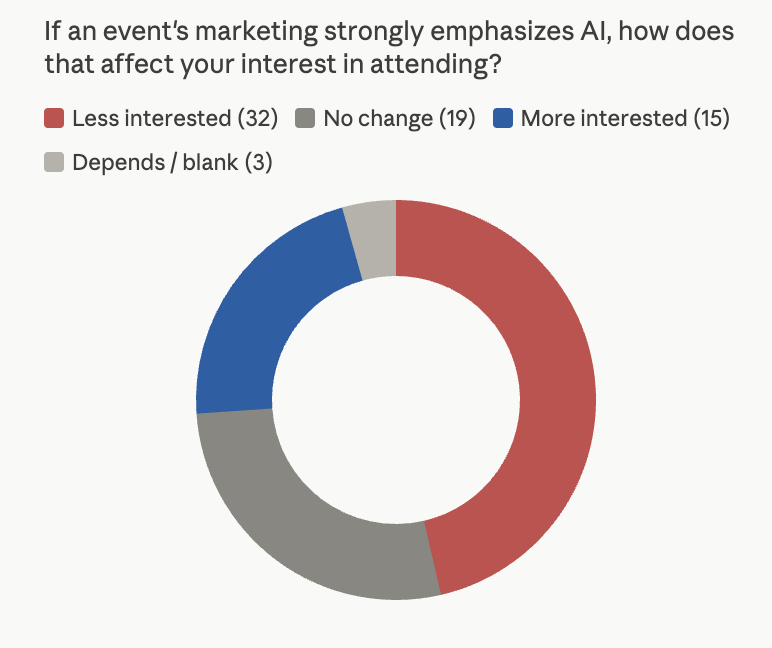
But what’s the right amount? We’ve previously had a full track (one session per hour) covering AI topics the last few years and while we felt we probably shouldn’t reduce this, a modest portion of attendees thought we should potentially cut back or eliminate AI-related content and focus instead on pure craftsmanship topics.
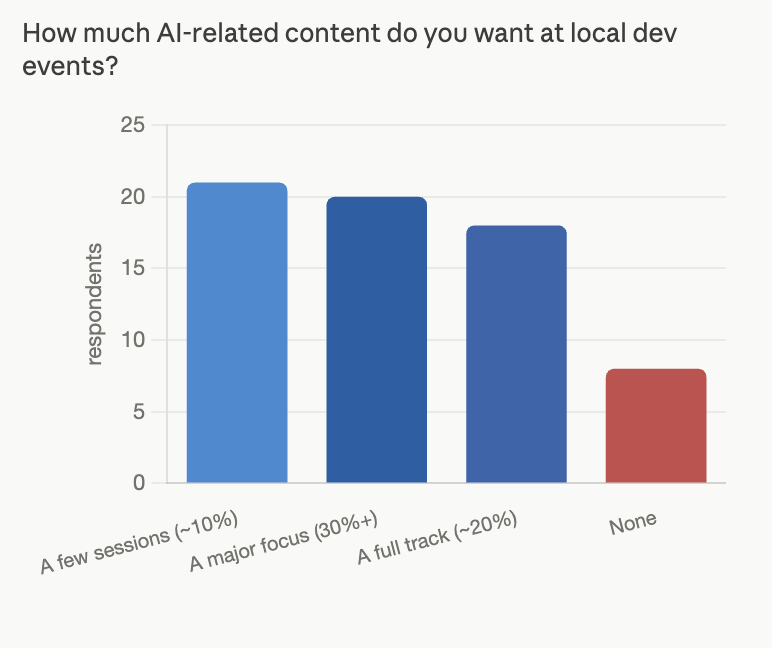
On the other hand, the barely majority stake wanted about the same amount of focus on AI versus prior years with another vocal crowd asking for more sessions covering AI.
However, looking at what attendees are looking to do in the next half year, we see that over 60% of attendees expect their AI use to increase, over half are already building with AI or building AI features into their applications, and nearly ¾ of respondents say that their orgs are rolling out AI initiatives or have already done so.
So, a third of our audience wants things to stay roughly the same, a third want increased AI focus, and a third want less or no AI content (rounding things to the nearest thirds here). What are we to do from this?
Desire for practical dev workflow demonstrations
One of our key insights is that attendees want to see practical examples of using these tools, not just learn about them. They’re looking for intermediate-to-advanced use cases involving AI tooling where they can see these topics applied to codebases that resemble real world problems and challenges they expect to need to solve.
Our audience uses a variety of tools and libraries at the moment with many attendees using more than one platform or tool.
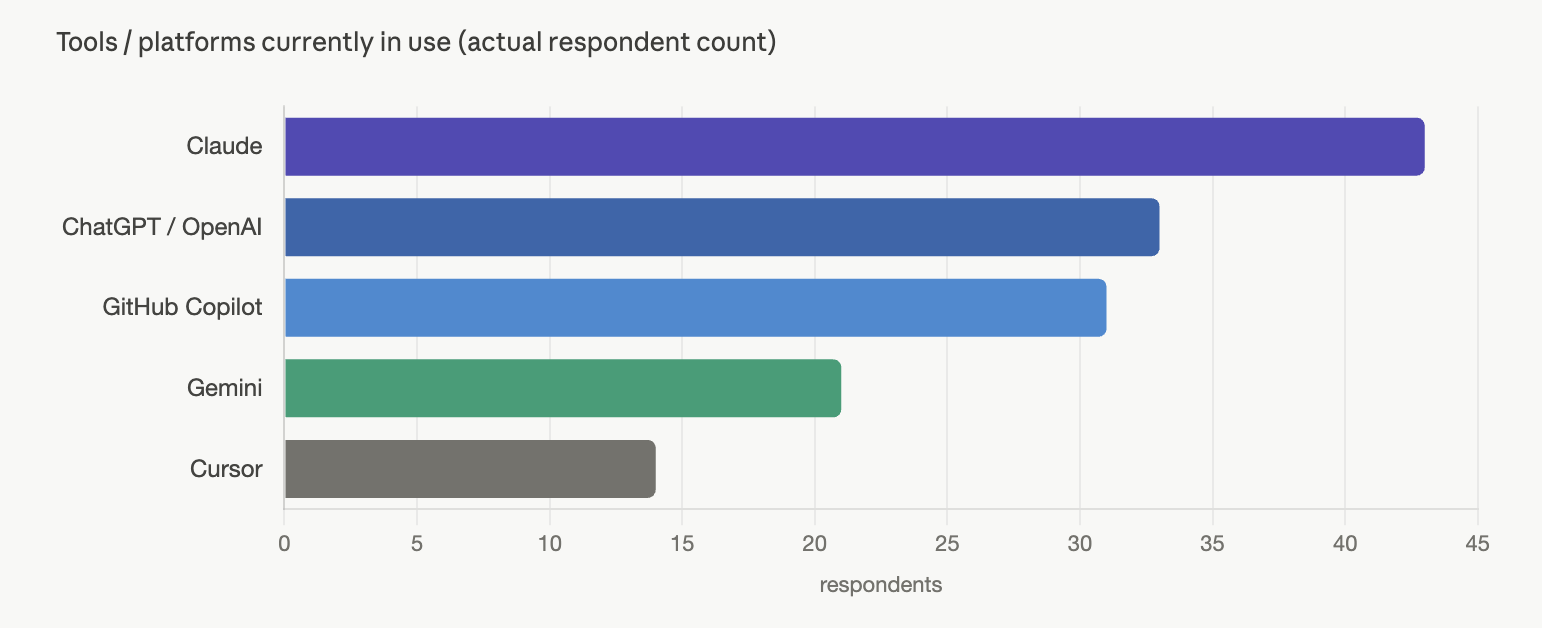
We expect the landscape of tools to continue to shift and grow over the months leading up to the conference as these tools continue to evolve, compete, and standardize.
Closing Thoughts
We hope you found the insights we’ve shared in this Greater Cincinnati AI Adoption Survey valuable and informative. While many of these findings aligned with our suspicions as a leadership team, we were genuinely surprised and interested in other insights.
We’re tremendously excited about Momentum 26 and are actively recruiting sponsors, volunteers, and preparing for our Call for Speakers which will last the month of May, followed by session review and acceptances in June prior to the conference on October 15th.
We hope to see you there and we’re so excited to see you this fall as technology and the greater Cincinnati area continue to grow and evolve.
If you haven't yet, checkout our followup article with our thoughts on how AI and AI based talks should be represented at Momentum